
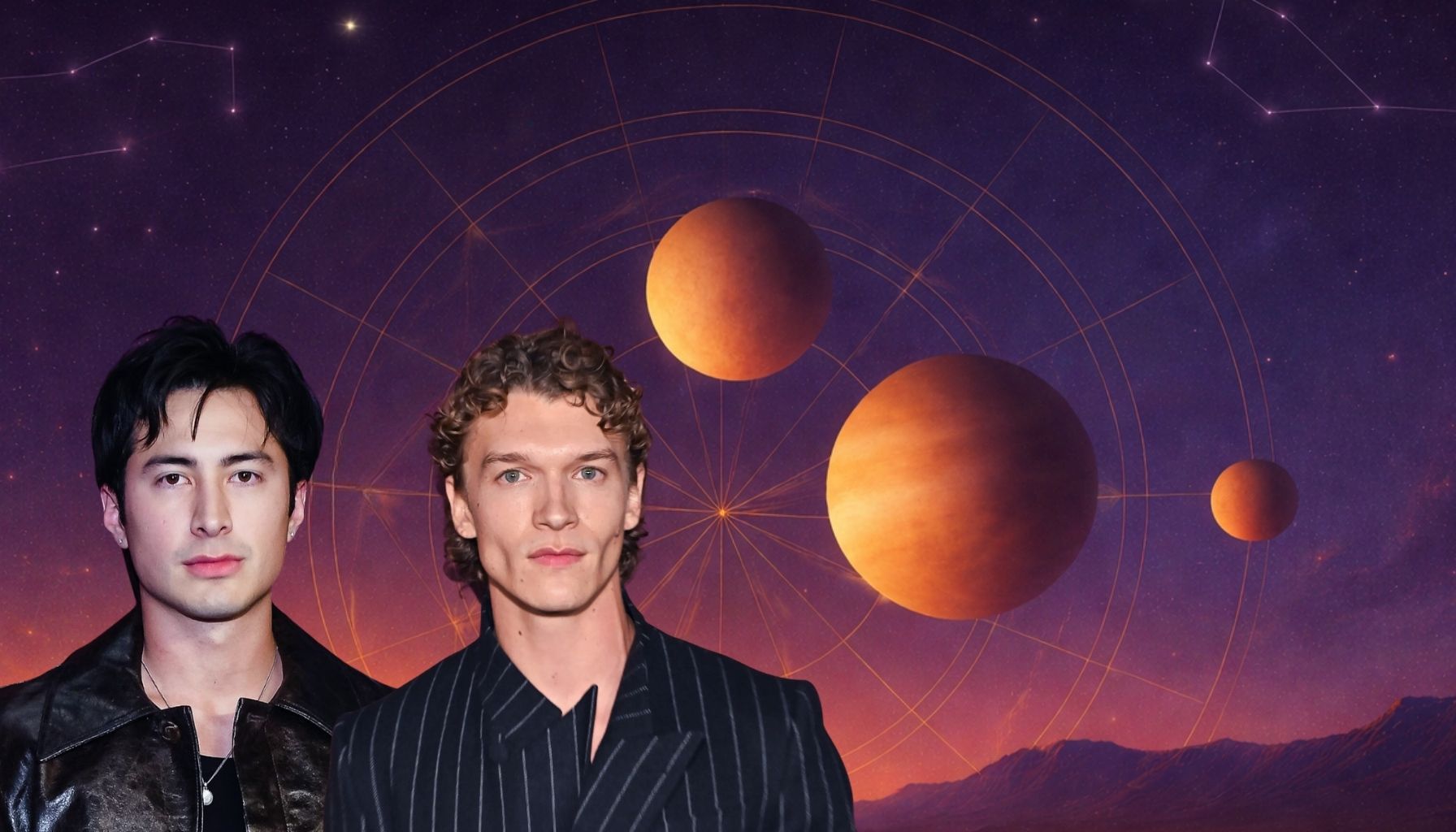
Why Heated Rivalry’s Chemistry Feels So Real, According to Astrology
Sometimes a series doesn’t just tell a story — it echoes a generation’s desires, fears, and the quiet identities that haven’t always had room to speak. Heated Rivalry is exactly that kind of show.
Its popularity isn’t driven by a single element. On one side, you have the physical world of sport — competition, endurance, speed, and strength. On the other, a subtler layer unfolds: intimacy, identity formation, and a private kind of longing. The audience watches as those two worlds rub against each other and spark.
Actors Hudson Williams (Shane Hollander) and Connor Storrie (Ilya Grigoryevich Rozanov) step into the frame not just as characters but as bodies navigating space, proximity, hesitation, and micro-tension. That’s why the show doesn’t simply sit between sports and romance; it asks a different question altogether: What happens when those two collide?
As the Camera Moves Closer, the Chemistry Speaks for Itself
For viewers, the first explanation is simple: good acting and good casting. But as the scenes keep unfolding, a different curiosity begins to surface: “Why does it feel this real?”
Within the Heated Rivalry fandom, theories quickly split. Some credited the actors’ personal energy, others pointed to the script and direction. And then a third voice emerged — what the sky might be saying about this encounter.
Because sometimes chemistry can’t be explained by technique alone; it’s shaped by rhythm, attraction, and an invisible field of tension. That’s exactly why looking at their birth charts suddenly felt so intriguing.
The question that lingered was: “Is this compatibility a coincidence?”
What Does the Sky Say About This Encounter?
In astrology, synastry (how two birth charts interact) and the composite chart (a chart that treats the relationship itself as its own “entity”) reveal how a connection actually functions.
What flows easily? Where does friction begin? Which planet wakes up which part of the other person?
Relationship astrology isn’t just for romantic couples. You can read these charts for friendships, family bonds, creative partnerships, or even two actors who need to share on-screen chemistry.
What made Heated Rivalry so intriguing was exactly this: understanding the nature of the pull happening behind the scenes.
When the chemistry feels too organic to be explained by acting alone, we look upward — and start with the basics:
- Hudson Williams — February 13, 2001 — Aquarius — Kamloops (Canada)
- Connor Storrie — February 22, 2000 — Pisces — Odessa (Texas)
Aquarius observes the scene from above: cool, analytical, a few steps removed. Pisces dissolves into the moment: intuitive, porous, and emotionally tuned to atmosphere.
One works like the “cool gaze” reading the scene from the outside; the other like the “immersed feeling” melting into it. When the camera frames both energies in the same shot, the result is a mix of restraint and overflow — the kind of tension that makes viewers think, “there’s no way this chemistry is accidental.”
Where Fire Meets Aesthetics: The Mars–Venus Collision
Connor’s Mars sits around 8° Aries; Hudson’s Venus lands at the exact same degree in Aries. In astrology, this kind of precision is called an exact conjunction — and when it happens between Mars and Venus, momentum accelerates fast.
Mars expresses desire with fire’s directness, while Venus in the same element turns that fire into flirtation, style, and erotic magnetism. Same element + same degree → competition shifting into flirtation almost instantly.
That’s why on screen we first see friction and rivalry; then the pace softens, the gaze lingers, the bodies align. When the camera closes in, these two energies don’t repel — they synchronize, and the flow begins.
The Language of Flirtation: When Two Venuses Speak the Same Tongue
Connor’s Venus sits in the cool, cerebral terrain of Aquarius, while Hudson’s Venus burns through Aries with urgency, directness, and instinct. Between them lies a roughly 60-degree sextile — an aspect astrologers associate with “effortless attraction.”
Sextiles start the game without forcing it: Air Venus thinks, observes, and styles; Fire Venus accelerates, advances, and brings the play onto the ice.
Which is why the flirting in Heated Rivalry isn’t just erotic — it’s aesthetic. The characters read one another, complete each other’s cues, and settle into the same frequency on screen. The audience doesn’t need it explained; they feel it: “This is exactly how these two would flirt.”
The Anatomy of Friction: Eros Steps In
In astrology, Eros represents the more primal, bodily, and subconscious dimension of desire. Connor’s Eros occupies the early degrees of Capricorn, while Hudson’s sits in the early degrees of Aries — creating a tight 90-degree square.
A square, in astrological terms, is friction — and friction produces heat. That’s why these scenes don’t just read as closeness; they hum with a low-voltage electricity, as if the bodies choose each other before the mind has time to negotiate.
Eros squares are rarely obvious, but they’re unforgettable. They make viewers ask the unspoken question: “Why are they looking at each other like that?”
The Mars–Neptune Haze: Between Fantasy and Reality
In their composite chart, Mars and Neptune occupy the same space. Mars governs the body, desire, and direct action; Neptune rules cinema, idealization, dreaming, and sometimes illusion.
When these two sit side by side, a cinematic haze appears: scenes drift between reality and fantasy, and the viewer can’t quite tell where acting ends and imagination begins.
In romantic relationships, Mars–Neptune can create ambiguity; on screen, however, it’s a perfect conduit for erotic fantasy. That’s the spell Heated Rivalry casts — two actors instinctively carrying the energy of a made-for-television desire.
This doesn’t imply they’re living out the storyline off camera; rather, we’re watching two charts collide in a way that produces an undeniably magnetic performance.
Is This Chemistry Fantasy, Reality, or Something In Between?
The point isn’t whether the actors are involved in real life, but how the on-screen chemistry becomes so convincing. Sometimes the camera catches an energy that transcends technique; the body language does the rest. In Heated Rivalry, the physical tension flows so naturally that the scenes barely need explanation.
And here’s the most interesting part: the dynamic may not signal a real-world romance, yet astrologically speaking, the match borders on ideal.

