
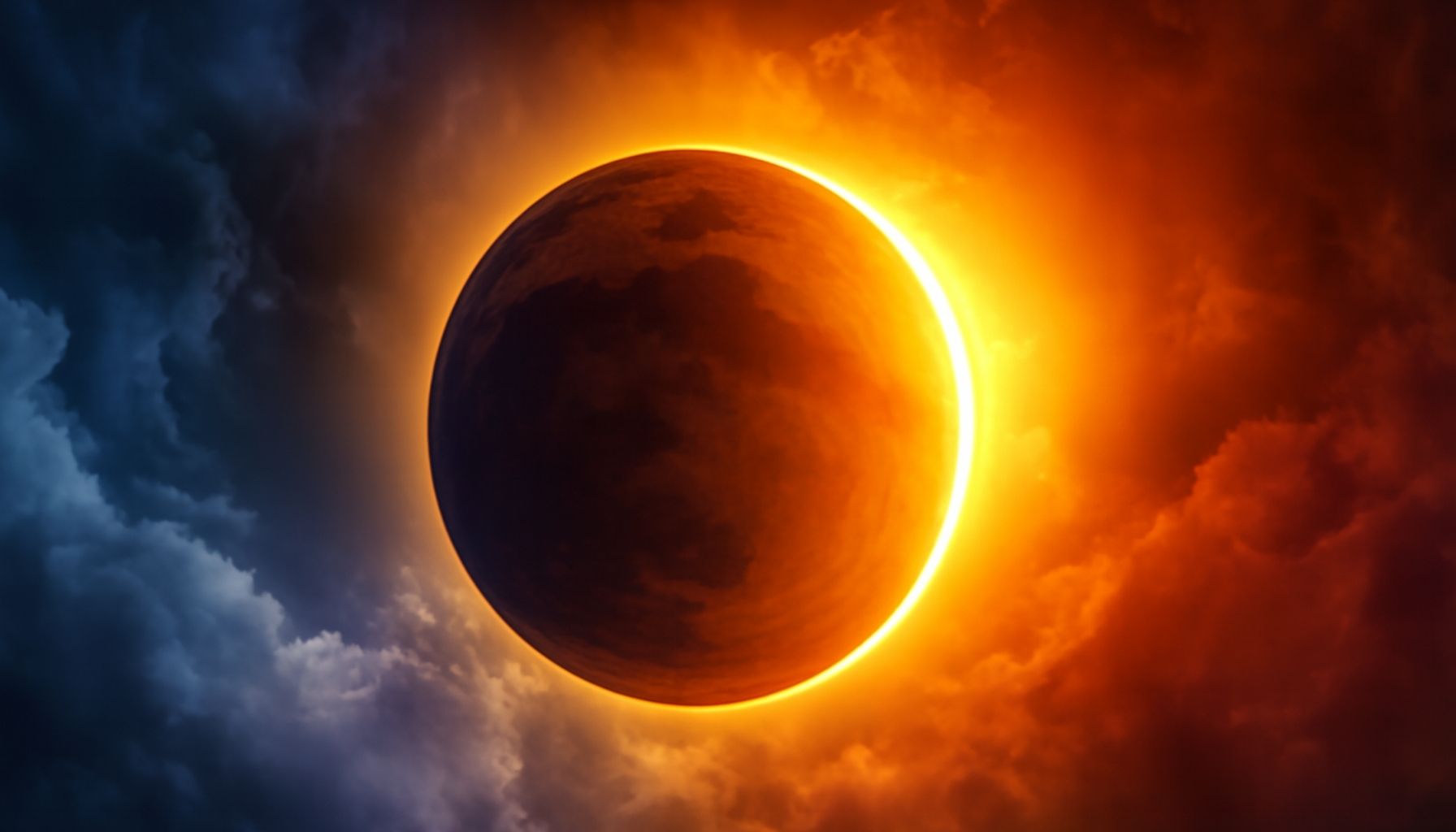
Eclipses: What Is the Meaning of Solar and Lunar Eclipses?
Eclipses are among the most fascinating events in the sky. Solar and lunar eclipses occur in different ways and hold deep meanings from both a scientific and astrological perspective. Throughout history, people have interpreted eclipses as signs of fate, while in the modern era, astronomy and astrology have approached these events from different viewpoints. In this article, you can find a comprehensive overview of how eclipses occur, their types, effects, and their scientific and astrological significance.
What Is an Eclipse and What Is the Origin of the Word "Eclipse"?
An eclipse is an event where one celestial body temporarily and either partially or completely covers another. The most well-known examples are solar and lunar eclipses. The Turkish word "tutulma" means the visibility of an object being obstructed. The Latin word "eclipsis" means "to disappear, to become invisible," and this concept is still used in Western languages. This origin shows that throughout history, eclipses have been associated with "loss" or "hiding" for humans.
According to historical sources, Babylonian, Chinese, and Greek civilizations regularly recorded eclipses, and in some empires, eclipses were seen as a "divine warning." For example, the war between the Lydians and Medes in 585 BCE ended during a solar eclipse. This event demonstrates that eclipses are not just celestial events but can also influence political and social affairs.
How Does a Solar Eclipse Occur and What Are Its Types?
A solar eclipse occurs when the Moon passes between the Earth and the Sun, partially or completely obscuring the Sun. This event can only happen during the new moon phase. When the Moon blocks the Sun's light, certain regions on Earth are plunged into darkness for a short time. However, this darkness is not seen all over the world; it can only be observed in the areas that fall within the Moon's shadow cone. A solar eclipse is considered both a fascinating scientific phenomenon and a symbol of new beginnings in astrology.
The types of solar eclipses vary depending on how the shadow cone falls on Earth:
- Total Solar Eclipse: The Moon completely covers the Sun, and day turns into night.
- Annular Solar Eclipse: When the Moon appears too small to completely cover the Sun, a bright ring of sunlight remains around it.
- Partial Solar Eclipse: The Moon covers only a portion of the Sun.
- Hybrid Eclipse: Appears as a total eclipse from some regions and an annular eclipse from others.
This variety leads to different interpretations of eclipses, both visually and spiritually.
How Long Does a Solar Eclipse Last and Where Can It Be Viewed?
The duration of a solar eclipse depends on the Moon's distance from Earth and the movement of the shadow cone across the Earth's surface. The maximum duration of a total solar eclipse is approximately 7 minutes and 30 seconds, but most eclipses are shorter. While partial or annular eclipses last longer, their effects are not as dramatic as a total eclipse. The Moon's shadow travels across the Earth's surface at a speed of about 1700 km/h during the eclipse, making it a brief but intense celestial spectacle.
Solar eclipses cannot be viewed from everywhere. They can only be observed along a narrow strip where the Moon's shadow falls. This strip is usually a few hundred kilometers wide. For example, the total solar eclipse that will occur in 2027 will be visible in regions extending from North Africa to the Middle East. For this reason, many astronomy enthusiasts choose to travel along the path of totality to experience this rare event. In astrology, it's believed that regardless of the viewing location, the effects of an eclipse manifest differently according to a person's birth chart.
How Does a Lunar Eclipse Occur and What Are Its Types?
A lunar eclipse occurs when the Earth passes between the Sun and the Moon, and the Moon enters the Earth's shadow cone. This event can only happen during the full moon phase. When the Earth blocks the Sun's light, the Moon appears in reddish, coppery, or brownish tones. A lunar eclipse can be viewed from a much wider area than a solar eclipse because the Earth's shadow is much larger than the Moon's. Therefore, lunar eclipses are considered more common and accessible for sky observation.
Lunar eclipses occur in three main types:
- Total Lunar Eclipse: The Moon completely enters the Earth's shadow cone and appears red.
- Partial Lunar Eclipse: Only a part of the Moon enters the shadow, and the rest remains bright.
- Penumbral Lunar Eclipse: The Moon only enters the Earth's outer, fainter shadow, resulting in a very slight dimming that is barely noticeable.
In astrology, lunar eclipses are generally associated with emotional closures, realizations, and significant confrontations in certain areas of life. Eclipses that occur near a person's natal Moon can have profound effects on their spiritual world.
What is a "Blood Moon" and How Does It Form?
The term "Blood Moon" arises when the Moon takes on a reddish color during a total lunar eclipse. This phenomenon occurs when sunlight, as it passes through the Earth's atmosphere, is refracted and only the red tones reach the Moon. So, the Moon doesn't actually turn red; it just appears that way to our eyes. The density of the atmosphere and the particles within it can cause the Moon's color to be closer to orange or coppery tones. This visual spectacle, commonly called a "Blood Moon," offers a very impressive view of the sky.
From a scientific perspective, this is a completely natural optical effect. However, in astrology, "Blood Moon" eclipses are associated with more intense emotional and spiritual effects. These periods are interpreted as a time for closing the past, bringing hidden issues to light, and triggering major transformations in certain areas of life. Especially "Blood Moon" eclipses that are connected to the lunar nodes in a birth chart are seen as fated turning points. Therefore, for both sky watchers and astrology enthusiasts, "Blood Moon" eclipses are a special point of interest.
What Do the Shadow Zones (Umbra, Penumbra, Antumbra) Mean in Solar and Lunar Eclipses?
To understand how eclipses are observed, it's necessary to know about the shadow zones. The umbra is the darkest and central part of the shadow. When the Moon or Sun enters this area, a total eclipse occurs. The penumbra is the lighter, outer part of the shadow; in this region, the eclipse is observed as fainter. The antumbra appears especially in annular solar eclipses; the Moon cannot completely cover the Sun, and a bright ring is visible around it.
From a scientific point of view, these shadow zones are the most important factors in distinguishing the types of eclipses. For example, in a lunar eclipse, if the Moon only passes through the penumbra, it is almost impossible to see it with the naked eye. However, when it enters the umbra, it turns distinctly red. Similarly, in a solar eclipse, because the umbra path is very narrow, only a small region can see the total eclipse, while those in the penumbra region see a partial eclipse. These differences explain why eclipses are very dramatic in some places and almost unnoticeable in others.
What is an Eclipse Cycle and How Does the Saros Cycle Work?
Eclipses are not random celestial events; they recur in a specific order. This order is called an eclipse cycle. The most well-known cycle is the Saros Cycle. The Saros Cycle lasts for approximately 18 years, 11 days, and 8 hours. At the end of this period, the Earth, Sun, and Moon return to a similar alignment, and a similar eclipse occurs. However, with each repetition, the eclipse is visible from a different part of the world.
Throughout history, astronomers have been able to predict eclipses thanks to the Saros Cycle. For example, the Babylonians discovered this cycle in the 600s BCE and began recording eclipses. Today, organizations like NASA also use this cycle as a basis for eclipse calculations. The Saros Cycle also has a place in astrology. Astrologers argue that eclipses tied to specific Saros series bring fated themes from the past to the forefront again. Thus, the Saros Cycle is a great point of reference for both celestial observations and spiritual interpretations.
How Many Eclipses Can Occur in a Year and Why Don't They Happen Every Month?
An average of 4 to 7 eclipses can occur in a year. These include both solar and lunar eclipses. However, an eclipse does not happen every month. The reason for this is that the Moon's orbit is tilted at an angle of about 5 degrees relative to the Earth's orbit. This means that the Earth's shadow does not fall on the Moon during every full moon, and the Moon cannot perfectly pass between the Earth and the Sun during every new moon. Eclipses only occur at the intersection points of these two orbits, which are called the lunar nodes.
From a scientific perspective, this situation represents a balance in the sky. If the Moon's orbit were on the exact same plane as the Earth's orbit, a lunar eclipse would occur every full moon, and a solar eclipse would occur every new moon. This would mean dozens of eclipses a year. Today, even the few eclipses that occur each year are a big event for sky watchers. In astrology, this is one of the reasons why eclipses are considered "fated." Because they are not frequent, they mark a special turning point in the sky.
How Do Eclipses Create Special Effects on Our Birth Chart?
One of the most important astrological features of eclipses is that they can create powerful effects on a personal birth chart. Especially when solar or lunar eclipses make contact with significant planets, the lunar nodes, or the ascendant degree in a person's birth chart, they can initiate fated transformations. For example, a solar eclipse occurring at a point close to your natal Sun can bring new beginnings in your career or great realizations about your life purpose. Similarly, a lunar eclipse can create powerful confrontations in personal relationships, family life, or the emotional world.
The reason eclipses are considered so important in astrology is that they hold the energies of both a beginning and an ending at the same time. Therefore, eclipses create turning points in personal development. Many astrologers emphasize that the effect of an eclipse is not limited to the day it occurs but covers a period of approximately 6 months before and after. This is one of the most important reasons why eclipses create long-term effects in birth charts.
The Sun and Moon eclipses may bring closures and new beginnings in your life. Discover your turning points in the eclipse reading tailored to your birth chart on the Astopia App. ✨🌌
What Factors Should Be Considered During Eclipses?
To correctly understand the effects of eclipses, there are several key factors to consider. First, the sign and degree in which the eclipse occurs are important. For example, an eclipse in Aries brings themes related to courage, new beginnings, and leadership to the forefront, while an eclipse in Capricorn emphasizes themes of career, discipline, and responsibility. The angles the eclipse makes with the planets in a person's birth chart should also be examined carefully. Hard aspects can signal difficulties, while harmonious aspects can indicate opportunities.
Furthermore, the type of eclipse is also important. Total eclipses create very powerful effects, while partial or penumbral eclipses are felt more subtly. In astrological interpretations, the lunar node near which the eclipse occurs is also taken into account; eclipses on the North Node indicate steps toward the future, while eclipses on the South Node indicate confronting situations from the past. Interpretations made by considering all these factors provide a clearer understanding of the role of eclipses in a person's life.
How Are Eclipses Related to Planets?
Eclipses are not only interpreted through the Sun and Moon; their relationships with personal and collective planets also determine their astrological significance. The planet an eclipse is conjoined with, opposing, or squaring creates different outcomes in our individual lives and in societal events. Therefore, eclipses are seen as powerful energetic catalysts in the sky.
Below is a list of the possible effects of eclipses' relationships with planets:
- With Mars: Issues of struggle, competition, courage, or anger outbursts may come to the forefront.
- With Venus: Love, relationships, aesthetic matters, or financial transformations are emphasized.
- With Jupiter: Connected with growth, opportunities, expansion, and sometimes excess.
- With Saturn: Responsibility, discipline, obstacles, and tests come to the forefront.
- With Uranus: Brings sudden developments, surprises, the need for freedom, and unexpected changes.
- With Neptune: Dreams, intuition, spiritual openings, or illusions come to the forefront.
- With Pluto: Triggers power struggles, deep transformations, crises, and rebirth processes.
These relationships prove that eclipses are not just celestial events but also astrological indicators that create fated turning points in human life.
What Do the Axes (Houses) Where Eclipses Occur Indicate?
One of the most powerful ways to understand the effects of eclipses in astrology is to examine which house they occur in a birth chart. This is because each house represents a different area of life. Eclipses create powerful beginnings, endings, or transformations in these areas. Therefore, the house where the eclipse occurs determines which areas of life a person will experience fated events.
Below is a list of the meanings of eclipses in different houses:
- 1st House (Self and Identity): Brings major changes in identity, appearance, personal attitude, and outlook on life.
- 4th House (Family and Roots): Points to transformations related to family, home, and childhood memories.
- 7th House (Relationships and Partnerships): Fated turning points occur in marriage, relationships, business partnerships, and close bonds.
- 10th House (Career and Status): Triggers significant developments in professional life, career, social status, and goals.
- 2nd House (Financial Resources): Affects money, income, financial security, and personal values.
- 5th House (Love and Creativity): New beginnings in love life, children, hobbies, and creativity may arise.
- 8th House (Crisis and Transformation): Effective in financial sharing, inheritance, debts, and transformation processes.
- 11th House (Friendships and Goals): Creates fated changes in friend groups, social circles, and future plans.
These effects of eclipses in the houses show which area of life the energy will be redirected. This is why astrologers primarily consider the house axes when interpreting eclipses.
How Are Eclipses Interpreted in Astrology?
Eclipses are generally considered "harbingers of fated events" in astrology. This is because eclipses occur on the lunar nodes. The lunar nodes are connected to a person's karma and spiritual journey. Therefore, astrological interpretations of eclipses point to developments that will create turning points in a person's life. For example, a solar eclipse is a harbinger of new beginnings, while a lunar eclipse is a harbinger of endings.
In astrological interpretations, eclipses are evaluated together with the planets, houses, and aspects in a person's birth chart. At the same time, the effects of eclipses are interpreted not only individually but also on a societal level. For example, an eclipse that falls in a country's economic house can be related to economic developments or crises. For this reason, eclipses are seen as major astrological signs that influence the future of both individuals and societies.

